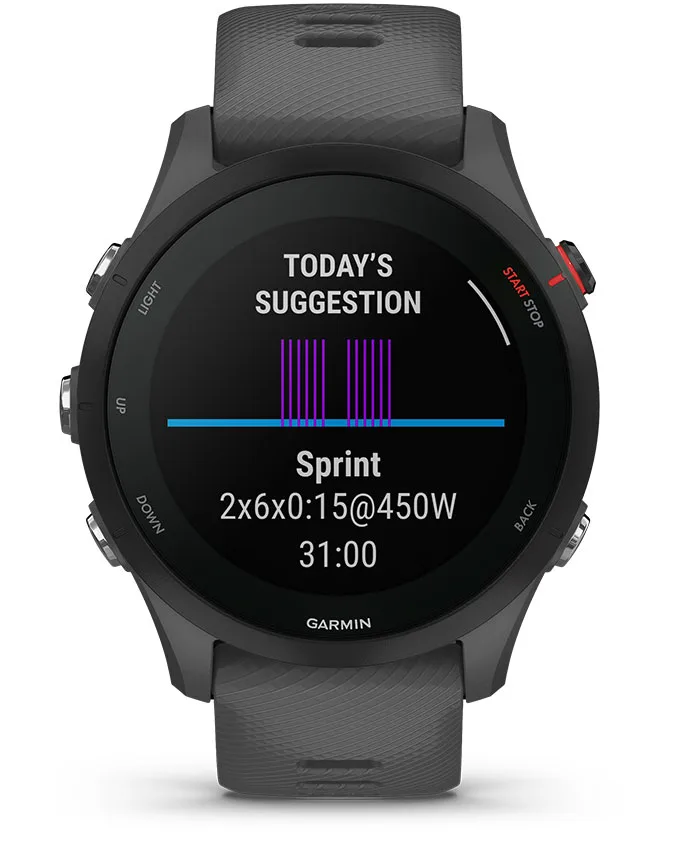
Garmin Forerunner 255 GPS Running Smartwatch 46mm
The Forerunner 255 suits runners who value multisport tools, readable controls and GPS tracking. The 14-day manufacturer rating and the review's 12% daily discharge describe different settings, so plan charging around your training rather than treating either as guaranteed. Accept breadcrumb navigation and button controls; pairing with Garmin Connect supports the connected workflow.
Updated 2026-10-08

We may earn a commission from qualifying purchases.
Prices and sellers
No price information yet
Conditions and limitations
Battery endurance depends on the activity mode
- Capability
- Manufacturer upper limits are 14 days in smartwatch mode and 30 hours in GPS mode.
- Limitations
- The review configuration uses one hour of multiband sport, about ten notifications and sport-only automatic backlight.
- Firmware and hardware revision were not specified for that test.
- Requirements
- Retain the manufacturer's mode when interpreting the specification.
Reported issues and fixes
An owner reported band tearing
- Status
- reported
- Symptom
- One owner reported tearing between two band notches after about 1.5 years of regular wear.
Who it suits
Choose training tools with known navigation limits
- Check before buying
- Try the controls and face on your wrist.
- Pair through Garmin Connect.
- Plan charging for your activity configuration.
- Constraints
- Accept breadcrumb navigation and button controls.
- Needs
- Running and multisport tracking.
- Reason
- The review supports the broad training fit, but navigation and control requirements may rule it out.
- Tradeoffs
- The reviewed training package does not include onboard maps, touchscreen input, ClimbPro or golf mode.
- Assessment
- conditional
Areas not yet researched (4)
No conclusion is available for these areas. This does not mean the Product has no limitations or reported issues.
- Compatibility
- Where sources differ
- Care and support
- Ownership costs
Reviewer consensus
Consensus rows require at least two distinct sources for the topic.
| Topic | Positive | Negative | Mixed | Reading | Evidence |
|---|---|---|---|---|---|
| Battery life and charging | 1 | 0 | 1 | Mixed · 1/2 | [6], [1] |
| Durability and water rating | 1 | 1 | 0 | Debated · 1 v 1 | [4], [2] |
Single-source notes
- Buyer fit: Agreed · 1/1 · [4]
- Comfort and fit: Agreed · 1/1 · [4]
- Comfort & usability: Agreed · 1/1 · [3]
- Display and controls: Agreed · 1/1 · [4]
- Sound / experience quality: Agreed · 1/1 · [3]
- Gps and sports accuracy: Agreed · 1/1 · [4]
- Health sensor accuracy: Agreed · 1/1 · [3]
- Limitations: Weak point · 1/1 · [4]
- Notifications and smart features: Agreed · 1/1 · [4]
- Phone platform and app: Agreed · 1/1 · [5]
The review
Garmin Forerunner 255: training depth with button-first controls
Daily use
The reviewed regular Forerunner 255 is described as a 49g watch with a transflective MIP display. The existing review highlights readability, while the owner specifically preferred the larger face because it was easier to read on their wrist. These are useful buying clues, not a universal comfort verdict. A readable screen can matter more than its appearance when you need to inspect data quickly, but a larger face is still a personal fit decision. Try the watch on and check the information you actually expect to read, rather than assuming that the owner's preference will transfer to your wrist. [3], [5], [4]
Connected features in the review include notifications, weather, calendar information, Garmin Pay and control of phone music. Garmin's setup instructions direct pairing through Garmin Connect. Decide which of those connected functions you will use before making them central to your choice. Phone music control should not be read as proof that this assigned watch stores music for listening without a phone. Likewise, the absence of touch input means that familiarity with the button interface is part of daily usability. Work through the pairing and controls before a first workout, so you can judge the routine rather than only the specification list. [4], [5]
What is missing
The cited review lists no onboard maps, ClimbPro, touchscreen or golf mode. Its description of navigation is breadcrumb based. Those omissions matter differently depending on the job you want the watch to do. A runner choosing a training record for familiar routes may find the training package more relevant than a map display. Someone who expects detailed map context on unfamiliar terrain should treat the map limitation as an important purchasing constraint. A breadcrumb route and a map are different kinds of information; the presence of navigation does not remove that distinction. [4]
The same reasoning applies to controls and specialised activities. If touch interaction or the named golf feature is a requirement, broad sport coverage is not a substitute for the missing function. Conversely, their absence need not undermine a purchase centred on running and multisport training. Start with the features you depend on during a session, then assess the rest of the package. Improved positioning can strengthen the activity record without providing the map interface you wanted. This is why the review's positive GPS assessment and its list of omissions should be read together: they describe different parts of the experience, rather than cancelling one another out. [4]
Training and GPS
The Forerunner 255 is a training-focused watch whose appeal lies in combining sport tracking with tools a runner can use over a longer training cycle. Yair Nisimov's review describes dual-band positioning as an advantage around buildings and tree cover, and places the watch among options for buyers who want a broad training package. Treat that assessment as the reviewer's experience, rather than a measured guarantee of location error. A recommendation about accuracy is useful context, but it is different from a repeatable number established on your own route. [3], [4]
The owner account adds a different kind of evidence: a person actually wearing the watch found it useful across workouts and saw heart-rate rises and falls during repeated intensity and recovery intervals. That supports using the record to inspect the shape of a session. It does not establish agreement with a laboratory reference or prove that every short peak is captured. If your purchase depends on very precise interval heart rate, ask for a reference comparison under that particular workload. For general training review, the existing observations are encouraging, provided that you keep this distinction between useful trends and independently validated accuracy. [3], [4]
Rated battery life is a mode-specific ceiling
Garmin's launch announcement gives the larger Forerunner 255 an upper limit of 14 days in smartwatch mode and 30 hours in GPS mode. These are manufacturer specifications, not elapsed runtimes measured by this research. The units and modes are different: days describe a daily-watch scenario, while hours describe activity tracking. They should not be combined into a promise that the watch will provide two weeks of daily GPS workouts. An upper limit is a useful planning reference only when you retain the setting that defines it. [6]
For a buyer, the important question is how much reserve remains after the activities they intend to record. Consider whether your normal use resembles a mostly everyday watch or a device tracking sport frequently, then look for evidence that matches the latter scenario. Leave room in your charging routine for differences in configuration and workload. The rated figure does not describe battery ageing, a different hardware revision or every combination of connected features. The independent discharge observation below helps make the distinction concrete, but neither source establishes a guarantee for an individual watch used years after the original test. [6], [1]
What the independent battery test actually measured
Sport Passion tested the larger blue Forerunner 255 and reported approximately 12% battery consumption per day with an hour of sport in multiband GPS mode. Its stated conditions also included about ten notifications and automatic backlight during sport only. This is a physical observation of percentage discharge under a described daily routine. It is not a subjective review rating, and it is not a measurement of twelve percent consumed during the exercise hour alone. Keeping that daily denominator matters when you compare the result with another test or plan your own charging. [6], [1]
The review did not identify the firmware or hardware revision for that result. Its finding therefore gives an example of the cost of a more active configuration, rather than a certified result for every later software version. The 12% observation and the 14-day manufacturer ceiling need not be a contradiction: the test describes its sport routine, while the ceiling names smartwatch mode. Avoid calculating an exact endurance promise from a rounded daily percentage. Track the battery after comparable days of your own training and keep a margin for a longer session, especially when the consequence of running out is losing the activity record. [6], [1]
Ownership: a replaceable band and a bounded durability report
A longer ownership account from PR Nerd reports a band tearing between two notches after about one and a half years of regular wear. The writer describes replacing it, rather than retiring the watch. This is a useful reminder to inspect the strap when considering ongoing ownership, particularly if you are choosing a used unit. It is one person's experience, not a statistical failure rate and not a prediction that every band will tear on the same schedule. The report cannot establish the state of the band supplied with another individual watch. [2]
Keep the scope of the observation in view: the report concerns a wearable component, and does not demonstrate a failure of the watch electronics. For buying decisions, inspect the condition of the particular unit and consider whether its everyday routine suits you. The training fit, button interface and Garmin Connect setup remain separate questions from strap wear. A favourable training review should not erase the ownership observation, and the ownership observation should not become an unsupported claim that the whole model is unreliable. These different evidence types answer different questions: what the watch can offer, how it is operated, and what one owner encountered over time. [4], [5], [2]
Measured performance
Daily battery discharge
12 %Reviewer observed battery percentage consumption during daily use. · n=1 · Sport Passion tested the larger blue Forerunner 255. About one hour of sport daily in multiband GPS mode, about ten notifications, and automatic backlight only in sport mode. Approximate observed daily consumption, not an isolated one-hour GPS drain measurement. Firmware and hardware revision were not specified.
Source [1]Buyer questions
Before you buy
What is the main GPS advantage?
The review reports more accurate dual-band positioning around urban canyons and tree cover. [4]
Setup
How does it connect to a phone?
Garmin instructs users to pair the watch through the Garmin Connect app. [5]
Everyday use
How did the owner describe heart-rate tracking?
The owner observed clear heart-rate changes across repeated high-intensity and recovery intervals. [3]
Limitations
Which features are absent?
The cited review lists no maps, ClimbPro, touchscreen, or golf mode. [4]
Care and maintenance
Is there a long-term band-wear report?
A PR Nerd owner reported a band tearing after about 1.5 years of regular wear. This is an individual experience, not a failure rate or guaranteed lifespan. [2]
Product images
Facts and specifications
Manufacturer datasheet
| Specification | Value | Source |
|---|---|---|
| Battery Life | 30 hours US; 14 days US | [6] |
Stated by reviewers
| Specification | Value | Source |
|---|---|---|
| Display Type | Transflective MIP | [4] |
| Interface | Incoming calls, messages, weather, calendar sync, Garmin Pay, and phone music controls. | [4] |
| Water Resistance | 5ATM | [4] |
| Weight | 49 g | [4] |
Other facts
| Specification | Value | Source |
|---|---|---|
| Buyer Fit | Buyers who want a broad training tool package.; Users who prefer a larger, readable watch face. | [3], [4] |
| Limitation | No maps, ClimbPro, touchscreen, or golf mode. | [4] |
| Risk | A PR Nerd owner reported the band tearing between two notches after about 1.5 years of regular wear. | [2] |
| Setup Requirement | Pair the watch with a phone using Garmin Connect. | [5] |
KnowSpec analysis
Training depth with explicit endurance conditions
The Forerunner 255 suits runners who value multisport tools, readable controls and GPS tracking. The 14-day manufacturer rating and the review's 12% daily discharge describe different settings, so plan charging around your training rather than treating either as guaranteed. Accept breadcrumb navigation and button controls; pairing with Garmin Connect supports the connected workflow.
Method: Synthesis of manufacturer specifications and an independent hands-on test, with owner observations treated as individual experience.Visible information gaps
Missing information is shown rather than guessed.
- Topic:Software Supportnot found
- Topic:Build Qualitynot found
- Topic:Privacy And Data Exportnot found
Products in this content
-
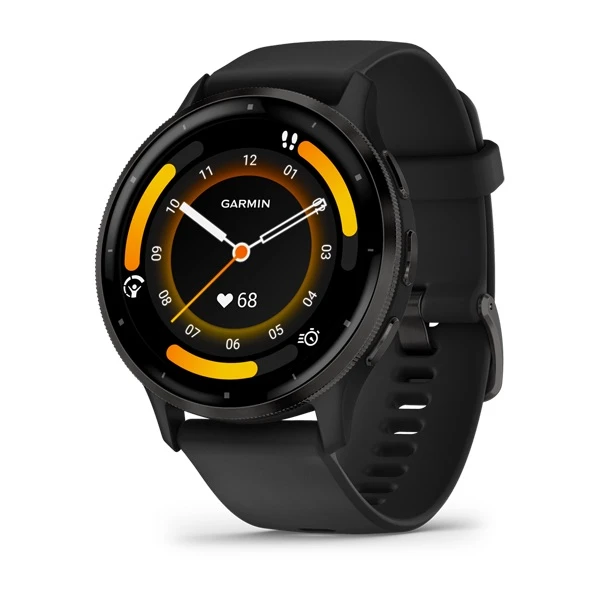
Garmin Venu 3, 45mm, Black
The Garmin Venu 3 fits buyers who want serious fitness tracking in a polished daily watch. Evidence supports comfortable all-day wear, a responsive wellness interface, an AMOLED display, measured GPS behavior, long smartwatch battery life,
-
Samsung Galaxy Watch Ultra (2024), 47mm, LTE, Titanium Gray
The Galaxy Watch Ultra fits Android buyers who want a premium rugged watch, a bright display, WearOS 5, dependable notifications, and substantial water resistance. Its strengths are balanced by evidence showing inaccurate heart-rate reading
-
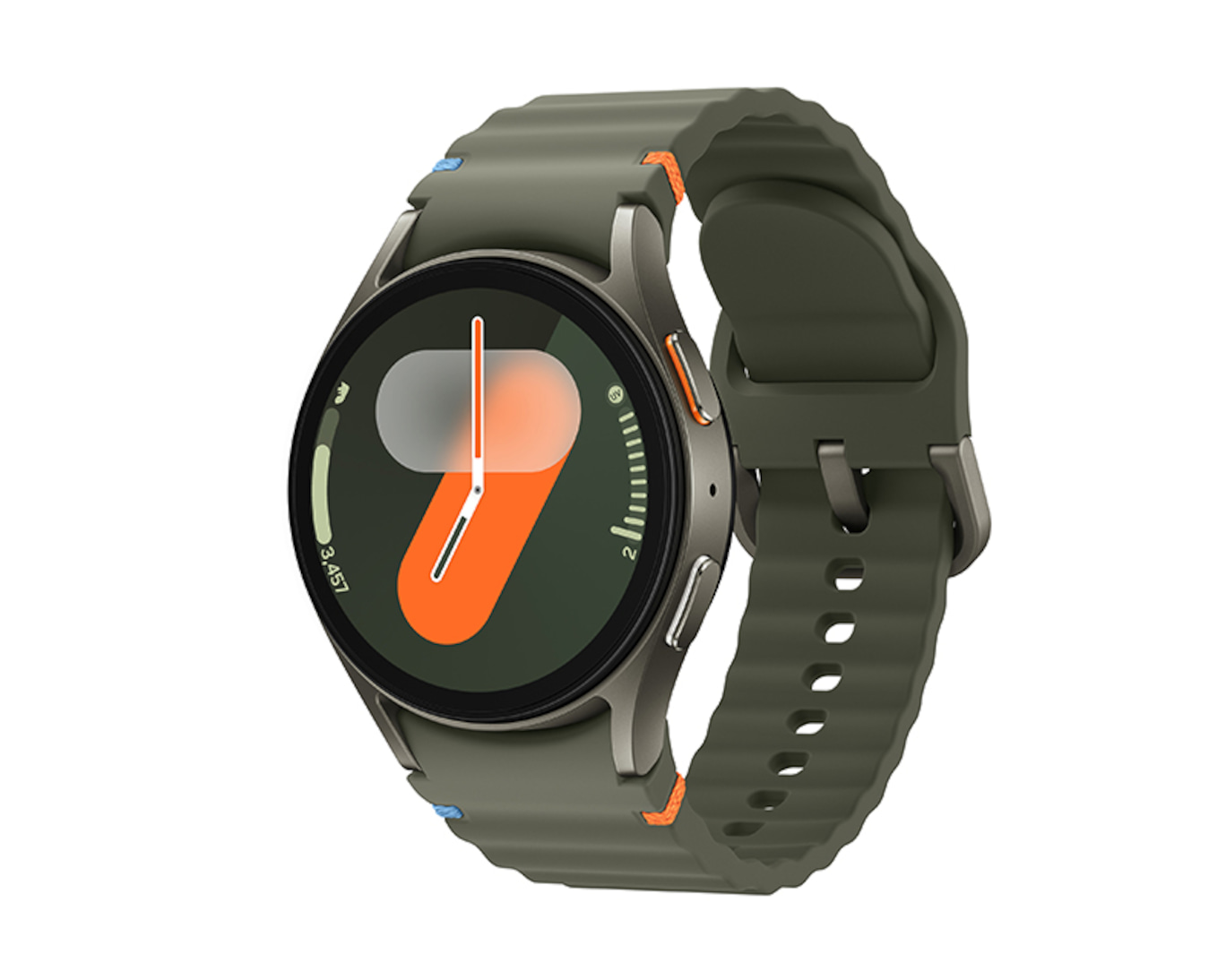
Samsung Galaxy Watch7 44mm LTE Smartwatch
The Galaxy Watch7 44mm LTE is a conditional fit for Android users seeking wrist notifications and connected features. Notebookcheck's German sample reached 1,884 cd/m²; a separate 44mm test reported 42 hours with the always-
-
Google Pixel Watch 3, 41mm Matte Black / Obsidian, Wi-Fi
The Pixel Watch 3 45mm fits Android users who value Google and Fitbit integration, a bright 2000-nit display, comfortable 45 mm design, rich notifications, measured heart-rate accuracy, and roughly 32.1 hours of always-on battery life. Its
-
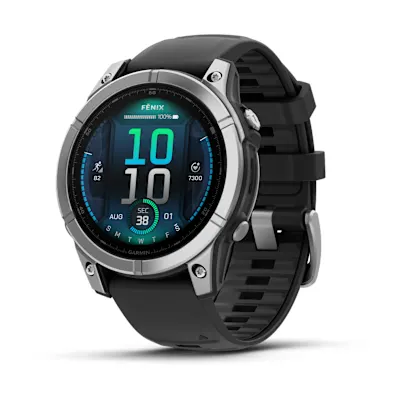
Garmin fēnix E – 47 mm, AMOLED, Stainless Steel with Black Band
The fēnix E is a conditional choice for recreational sport users who want Garmin's core sports functions and can accommodate its watch size. A tester found it comfortable and i
-
Apple Watch Series 10 GPS 42mm Jet Black Aluminum Case with Black Sport Band - M/L
Apple Watch Series 10 fits iPhone users who want a thin daily smartwatch with strong running and health evidence. It combines a 9.7 mm case, br
Sources and method
- Test Garmin Forerunner 255 and 255 MusicSport Passion · retrieved 2026-10-08Lab review
- Garmin Forerunner 255 Review: 2 Years LaterPR Nerd · retrieved 2026-10-08Owner community
- Garmin Forerunner 255 review after a few monthsEspresso Insight · retrieved 2026-09-27Owner community
- Garmin Forerunner 255 ReviewYair Nisimov · retrieved 2026-09-27Editorial review
- Forerunner 255 Series Owner's ManualGarmin · retrieved 2026-09-27ManualPDF
- Garmin celebrates Global Running Day with the introduction of the Forerunner 255 seriesGarmin · retrieved 2026-10-08Manufacturer