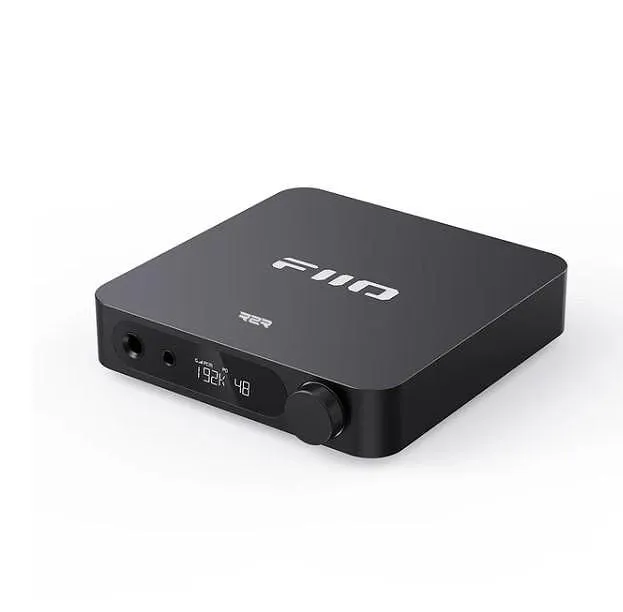
FiiO K11 R2R Desktop DAC and Headphone Amplifier, Black
The K11 R2R fits a wired desktop listener who wants to explore R-2R conversion with headphones and an RCA speaker path. Headfonics favors its relaxed warmth but reports reduced detail, particularly in NOS; Pragmatic Audio enjoyed listening yet preferred the original K11 for analytical neutrality. These are preferences, not physical benchmarks. Its 1.3 W per-channel balanced rating applies to 32Ω in OS with THD+N below 1%, so matching a headphone requires more than reading the largest power number.
Updated 2026-10-08

We may earn a commission from qualifying purchases.
Prices and sellers
No price information yet
Conditions and limitations
Documented input ceilings, external power and OS-rated output are verified; sustained-load tests remain unavailable.
Compatibility
One named active-speaker pairing is documented; operating-system and console compatibility remain unverified.
Where sources differ
Listening assessments differ by pairing and preference; no matched-condition numerical conflict has been verified.
Reported issues and fixes
Sensitive-IEM noise is reported second-hand by Hifitopia, which did not hear it in its two named IEM pairings; incidence and fixes are unknown.
Care and support
USB firmware upgrading is listed, but US warranty terms, repairability and a dated support commitment were not established; European seller terms do not prove US coverage.
Ownership costs
External supply requirements are established. Wall power, energy cost, US repair charges and lifetime cost remain unknown; no prices were collected.
Who it suits
Desktop fit, line-output constraints and reviewer preferences are supported; universal headphone suitability and comparative bench superiority are not.
The review
FiiO K11 R2R: a relaxed entry to desktop R-2R listening
What it is for
The FiiO K11 R2R is a desktop DAC and headphone amplifier for listeners who want to explore resistor-ladder conversion in a wired audio system. Its practical appeal is the combination of headphone outputs and an RCA speaker path, rather than a promise that one conversion architecture improves every recording. Audio Review identifies desktop R-2R experimentation with balanced headphones as its intended fit, but that site's assessment is research-based, not a laboratory test. A useful first purchasing question is therefore about the system you will connect. If your source has a compatible digital output and your headphones or speaker amplifier match the available analog connections, the device addresses that workflow. If your priority is Bluetooth or balanced line-level connections, its documented omissions matter more than enthusiasm for the R-2R label. The external supply also makes it a desk component rather than a self-contained battery device. [7], [1]
The balanced 4.4mm headphone socket should not be confused with a balanced output for a speaker amplifier. The line-level path uses RCA, and the research-based review describes both fixed line output and variable preamp operation. This distinction matters when choosing where volume is controlled: the destination amplifier and the selected output mode need to fit the same plan. Hifitopia provides a concrete example by connecting the K11 R2R in Line Out mode to Edifier MR4 2.0 active speakers with an Atlas Element Integra cable. That is evidence of one actual listening setup, not certification that every speaker, cable or amplifier works identically. Buyers considering both speakers and headphones should check their intended signal path before ordering accessories. A compatible headphone connector and a compatible speaker input are separate requirements, even though both functions occupy the same desktop enclosure. [1], [6], [5], [7]
Sound and operating modes
Headfonics describes a warm and relaxed presentation, alongside reduced microdetail and midrange dynamics. Its comments are listening impressions, so they should guide an audition rather than be treated as numerical measurements of accuracy. The reviewer also found that NOS reduced perceived midrange and high-frequency resolution, especially in complex mixes, while OS provided a more complete balance of detail and warmth. The useful buyer implication is to compare the two settings using familiar recordings before deciding that the more relaxed presentation suits your priorities. A listener who wants to hear fine separation in busy arrangements may judge the compromise differently from someone seeking an easygoing presentation. The original article's relaxed-listening emphasis remains relevant, but it needs that qualification. Neither the positive description of warmth nor the negative description of reduced detail establishes what every listener will hear through every headphone pairing. [3]
Pragmatic Audio offers another useful perspective: its reviewer enjoyed the K11 R2R during NOS listening but ultimately preferred returning to the original K11 for analytical neutrality. That combination of enjoyment and a different final preference is more informative than treating the R-2R version as an automatic upgrade. It suggests a choice about listening priorities, supported by an actual hands-on review, rather than a universal hierarchy between conversion types. The documented OS/NOS selection gives the buyer a way to explore that choice within this device. The three gain settings serve a different purpose and should not be mistaken for additional sampling modes. When comparing impressions, keep the selected sampling mode and headphone pairing in mind. A favorable reaction in one arrangement can coexist with another reviewer's preference for a more analytical source, without either opinion becoming a physical benchmark or a guaranteed outcome. [3], [1], [6], [2]
Desktop capability
FiiO rates the balanced headphone output at at least 1.3 W per channel into 32Ω in OS mode, with THD+N below 1%. This is a manufacturer specification under stated conditions, not an independent measurement performed for this research. The distinction prevents the largest headline number from becoming a promise about every headphone or operating mode. A buyer should compare the stated load, output connection and mode with the intended setup before drawing conclusions about available headroom. Format support likewise depends on the input. USB accepts PCM up to 384kHz at 32-bit and DSD256, whereas coaxial is listed at 192kHz/24-bit and optical at 96kHz/24-bit. A transport connected through optical does not acquire the USB ceiling merely because the same converter offers USB. Match the source's actual output to the relevant input specification, then consider the files you intend to play. [1]
The connection list includes USB-C data input, optical and RCA coaxial input, RCA line output, and the two headphone sockets. FiiO specifically limits the coaxial digital output to USB mode. This is a useful detail if the intended arrangement sends computer audio onward to another digital component: an input and an output sharing the coaxial name do not imply unrestricted pass-through from every source. The supply specification is DC 12V/2A, with no battery. Those adapter figures describe the required supply and its capacity; they do not establish measured electricity consumption. The encoder knob combines volume adjustment and menu confirmation, while L/M/H gain and OS/NOS selection are documented settings. Before buying, check the connectors, the available power location and where volume will be controlled. Those concrete requirements determine whether the unit fits the desk more directly than an unsupported claim about sound improvement. [1], [6], [7]
What remains uncertain
The available verified evidence does not establish sustained-load behavior or measured operating efficiency, and this revision records no independently verified physical benchmark. A public measurement article was located, but its page exceeded the native snapshot size limit; other candidate reviews were blocked by robots rules or returned a bot challenge. This is an evidence-access limitation, not evidence that the product lacks performance or that every published test is invalid. US warranty terms, repairability and a dated support commitment also remain unresolved; a European seller's terms should not be transferred to this US ASIN. The resulting recommendation is conditional and practical. Consider the K11 R2R when a wired desktop headphone and RCA speaker workflow meets your needs and you want to explore its modes. Reconsider if Bluetooth, balanced line output or independently verified sustained-performance results are essential to your decision. [1], [7]
Sensitive-IEM noise needs careful attribution. Hifitopia relays reports of background noise with sensitive IEMs, but explicitly says it did not detect that problem with Yanyin Moonlight Ultra or Dita Project-M. Its direct observation and the reports it heard are different kinds of evidence. They support checking the intended pairing, not declaring either universal silence or a confirmed defect in every unit. The reviewer's numerical ratings also express editorial judgments rather than physical quantities, so none is recorded here as a measured performance result. For a buyer with a particularly sensitive earphone, the useful next step is to assess that exact pairing and source arrangement. The broader sound guidance remains similarly conditional: Headfonics' relaxed warmth and Pragmatic Audio's preference for analytical neutrality describe priorities worth comparing. They should not become claims that a conversion topology guarantees one sound signature in every system. [3], [2], [5]
Buyer questions
Before you buy
Who is the FiiO K11 R2R for?
Desktop listeners exploring R-2R conversion with balanced headphones and a compatible wired source. [7]
Compatibility
Does it support high-resolution USB playback?
Yes. Manufacturer evidence documents high-resolution PCM and DSD decoding over USB. [1]
Everyday use
How does the sound presentation lean?
The review describes a warm, laid-back presentation, with reduced microdetail and midrange dynamics. [3]
Limitations
What is the main NOS-mode limitation?
Headfonics perceived reduced midrange and high-frequency resolution in NOS, especially in complex mixes. This is a listening judgment. [3]
Product images
Facts and specifications
Manufacturer datasheet
| Specification | Value | Source |
|---|---|---|
| Compatibility | USB: PCM 384kHz/32-bit and DSD256; coaxial: PCM 192kHz/24-bit; optical: PCM 96kHz/24-bit. | [1] |
| Interface | Three L/M/H gain settings, OS/NOS selection and volume/menu encoder knob.; USB-C data input, optical input, RCA coaxial input/output, RCA line output, 4.4mm balanced headphone output and 6.35mm headphone output. | [1], [6] |
| Power | 1.3 W | [1] |
| Power Source | DC 12V/2A external supply; no battery. | [1] |
Stated by reviewers
| Specification | Value | Source |
|---|---|---|
| Buyer Fit | Desktop listeners exploring R-2R conversion with balanced headphones.; Pragmatic Audio enjoyed NOS listening but preferred returning to the original K11 for analytical neutrality. | [7], [2] |
| Compatibility | Hifitopia used K11 R2R Line Out with Edifier MR4 2.0 and an Atlas Element Integra cable. | [5] |
| Interface | RCA fixed line and variable preamp modes; no balanced line output and no Bluetooth. | [7] |
| Limitation | Headfonics perceived a loss of midrange and high-frequency resolution in NOS, particularly with complex mixes.; Hifitopia heard no background-noise problem with Yanyin Moonlight Ultra and Dita Project-M, but only relayed sensitive-IEM noise reports. | [3], [5] |
KnowSpec analysis
Who the FiiO K11 R2R suits
The K11 R2R fits a wired desktop listener who wants to explore R-2R conversion with headphones and an RCA speaker path. Headfonics favors its relaxed warmth but reports reduced detail, particularly in NOS; Pragmatic Audio enjoyed listening yet preferred the original K11 for analytical neutrality. These are preferences, not physical benchmarks. Its 1.3 W per-channel balanced rating applies to 32Ω in OS with THD+N below 1%, so matching a headphone requires more than reading the largest power number.
Method: evidence_synthesisVisible information gaps
Missing information is shown rather than guessed.
- Topic:Measured Performancenot public
- Topic:Efficiencynot found
- Topic:Sustained Performancenot found
Sources and method
- K11 R2R ParametersFiiO · retrieved 2026-09-27Manufacturer
- FiiO K11 R2RPragmatic Audio · retrieved 2026-10-08Editorial review
- FiiO K11 R2R ReviewHeadfonics · retrieved 2026-09-27Editorial review
- K11 R2R ParametersFiiO · retrieved 2026-10-08Manufacturer
- Fiio K11 R2R ReviewHifitopia · retrieved 2026-10-08Editorial review
- FiiO K11 R2R Desktop DAC & Headphone AmplifierAudioline Ltd. · retrieved 2026-10-08Retailer listing
- FiiO K11 R2R ReviewAudio Review · retrieved 2026-09-27Editorial review