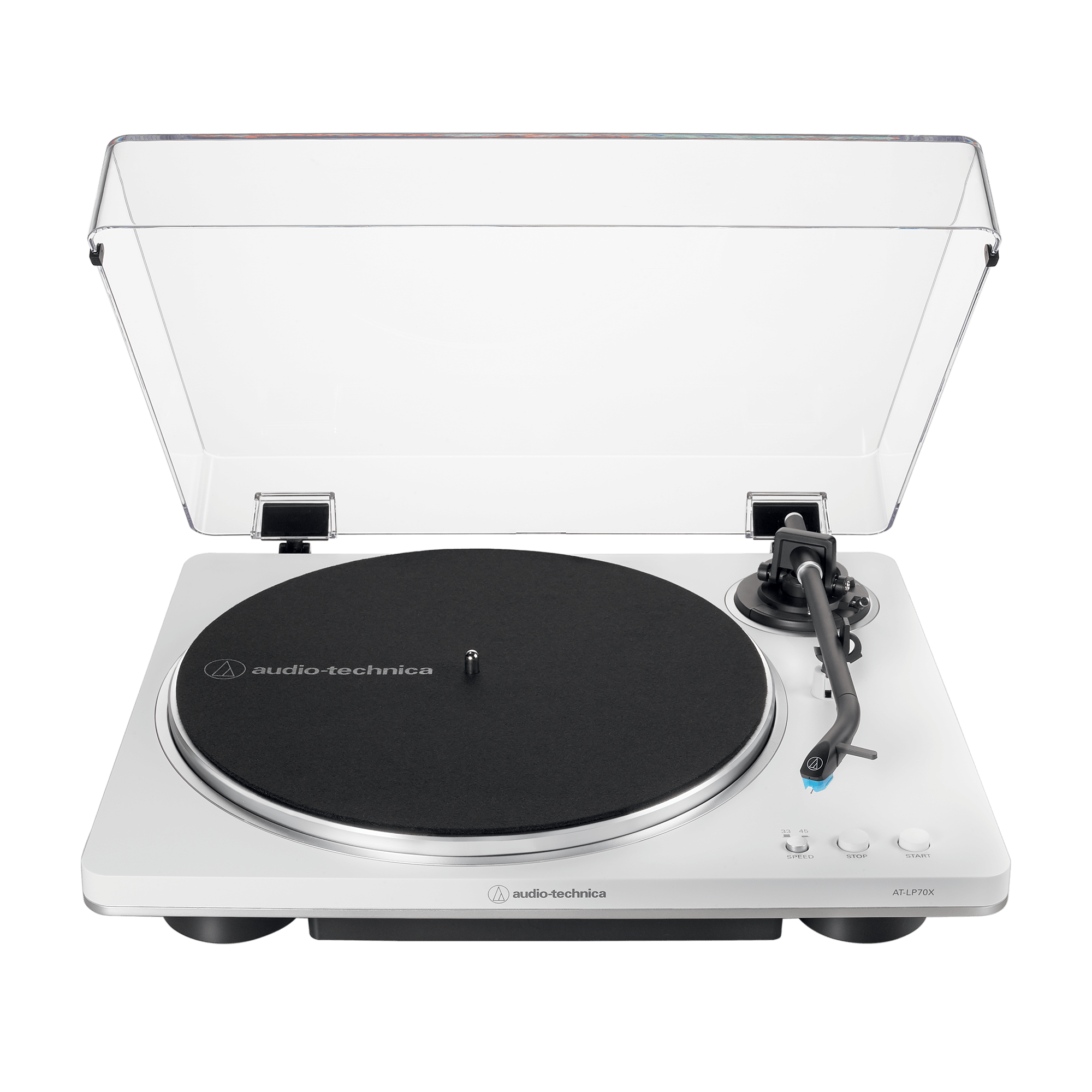
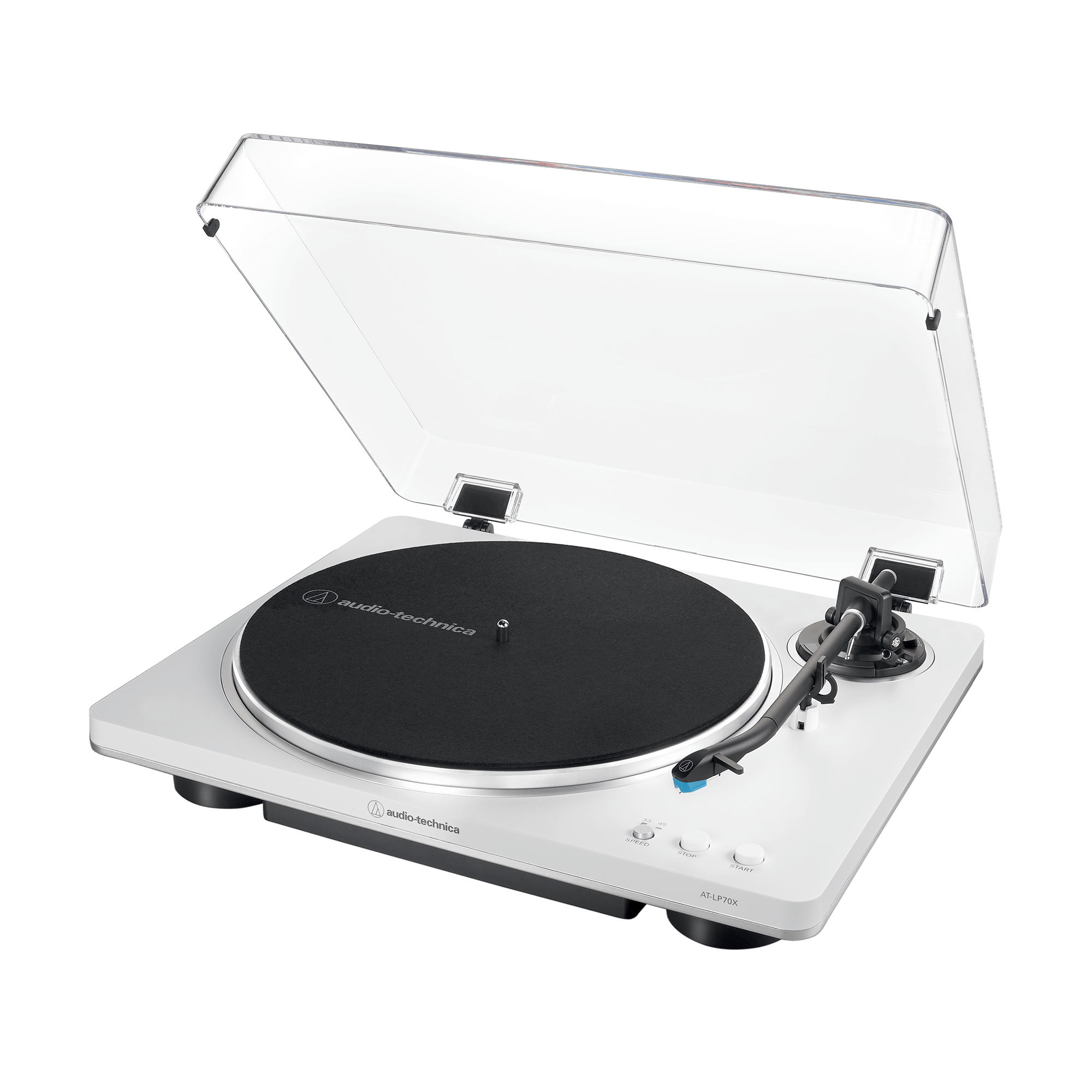
Audio-Technica AT-LP70X Fully Automatic Belt-Drive Turntable (White/Silver)
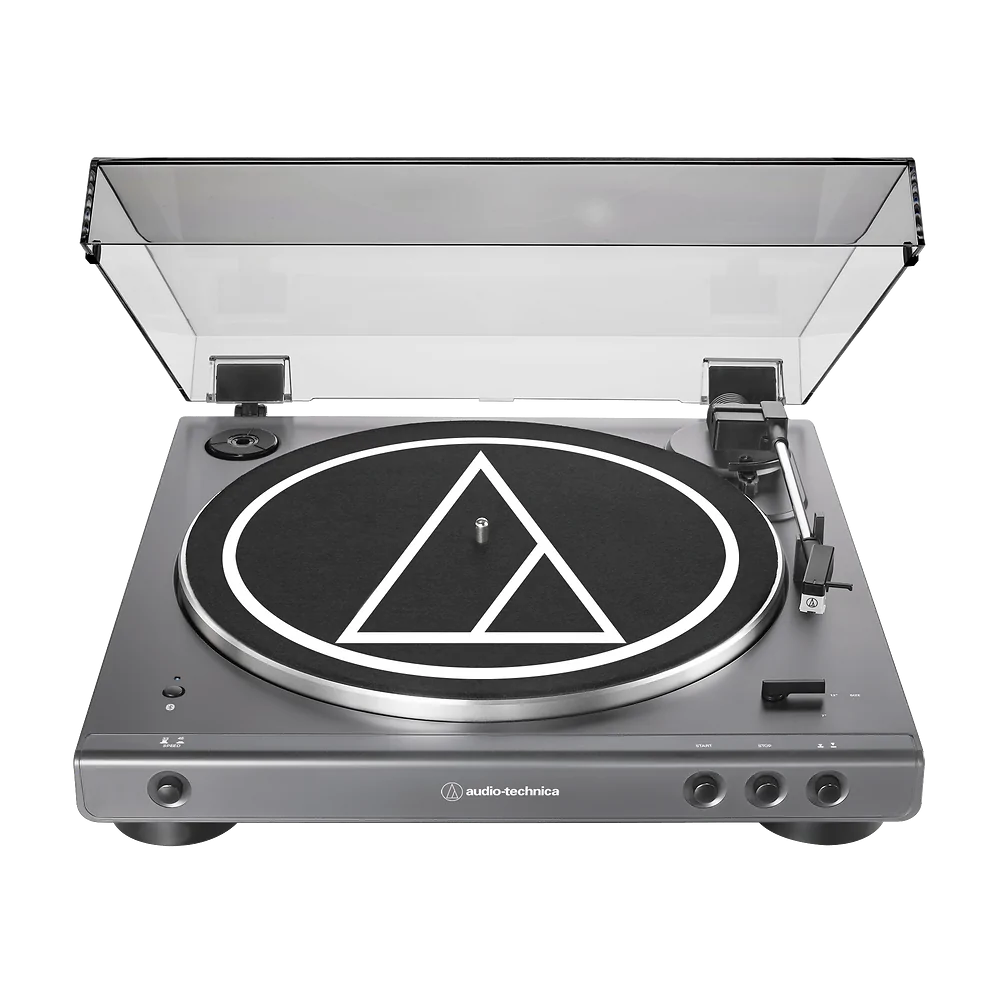
The AT-LP70X suits first-time vinyl buyers who want automatic start and return, 33-1/3 RPM and 45 RPM playback, and a built-in phono stage. Its fixed AT-VM95C cartridge simplifies the choice but prevents broader cartridge swapping; compatible styli remain the upgrade route. Manufacturer wow-and-flutter and signal-to-noise limits describe published specifications, not measured performance of the assigned unit. Buyers should check speaker inputs, choose the matching output setting, and accept the manual's caveat that some records may not trigger automation correctly.
Updated 2026-10-08

We may earn a commission from qualifying purchases.
Prices and sellers
No price information yet
Conditions and limitations
Automatic playback has record and setup limits
- Capability
- Automatic start and end-of-record tonearm return.
- Limitations
- Automation may not work at the start or end of some records.
- Requirements
- Place the turntable on a level surface.
Reported issues and fixes
The public US and Canadian LP70X service notices were read, but native snapshots were denied by robots policy. Exact affected hardware revisions and an independently verified failure rate remain unavailable.
Care and support
Replaceable stylus, fixed cartridge
- Details
- The cartridge is fixed, while AT-VMN95C is a compatible replacement stylus. The manual gives 300 hours of use as a replacement rule of thumb, not a guaranteed lifespan.
Ownership costs
Stylus replacement guidance and compatible parts are documented. No price observations or monetary ownership calculation are included.
Who it suits
Article and analysis explain automatic operation, input matching, and the fixed-cartridge tradeoff. No price-ranked or matched-laboratory recommendation is made.
Areas not yet researched (2)
No conclusion is available for these areas. This does not mean the Product has no limitations or reported issues.
- Compatibility
- Where sources differ
Reviewer consensus
Consensus rows require at least two distinct sources for the topic.
| Topic | Positive | Negative | Mixed | Reading | Evidence |
|---|---|---|---|---|---|
| Automation and controls | 3 | 0 | 0 | Agreed · 3/3 | [7], [6], [1] |
| Sound / experience quality | 1 | 0 | 1 | Mixed · 1/2 | [4], [2] |
| Phono stage and outputs | 2 | 0 | 1 | Leans positive · 2/3 | [6], [1], [2] |
| Speed accuracy | 3 | 0 | 0 | Agreed · 3/3 | [5], [7], [1] |
| Upgradeability and service | 2 | 0 | 1 | Leans positive · 2/3 | [4], [3], [7] |
Single-source notes
The review
Audio-Technica AT-LP70X: automatic playback and an upgradeable stylus path
Automatic operation and connections
Automatic operation is central to the AT-LP70X's appeal. The START control initiates playback, and the manual describes automatic tonearm return when the record reaches its end. Recordbuilds independently describes the model as fully automatic. For a new listener, these controls reduce the number of arm movements needed during normal playback, which explains the deck's convenience without making a claim about measured reliability. There is a qualification worth keeping beside the headline feature: the manual warns that automatic operation may not work at the start or end of songs on some records. Treat the feature as the intended operating method, rather than a promise that every pressing will behave identically. A buyer who wants automatic playback can reasonably consider this model, but should retain the operating instructions and pay attention to an unexpected start or return. The documentation supports the mechanism and its caveat; it does not provide a quantified failure rate. [6], [1], [7]
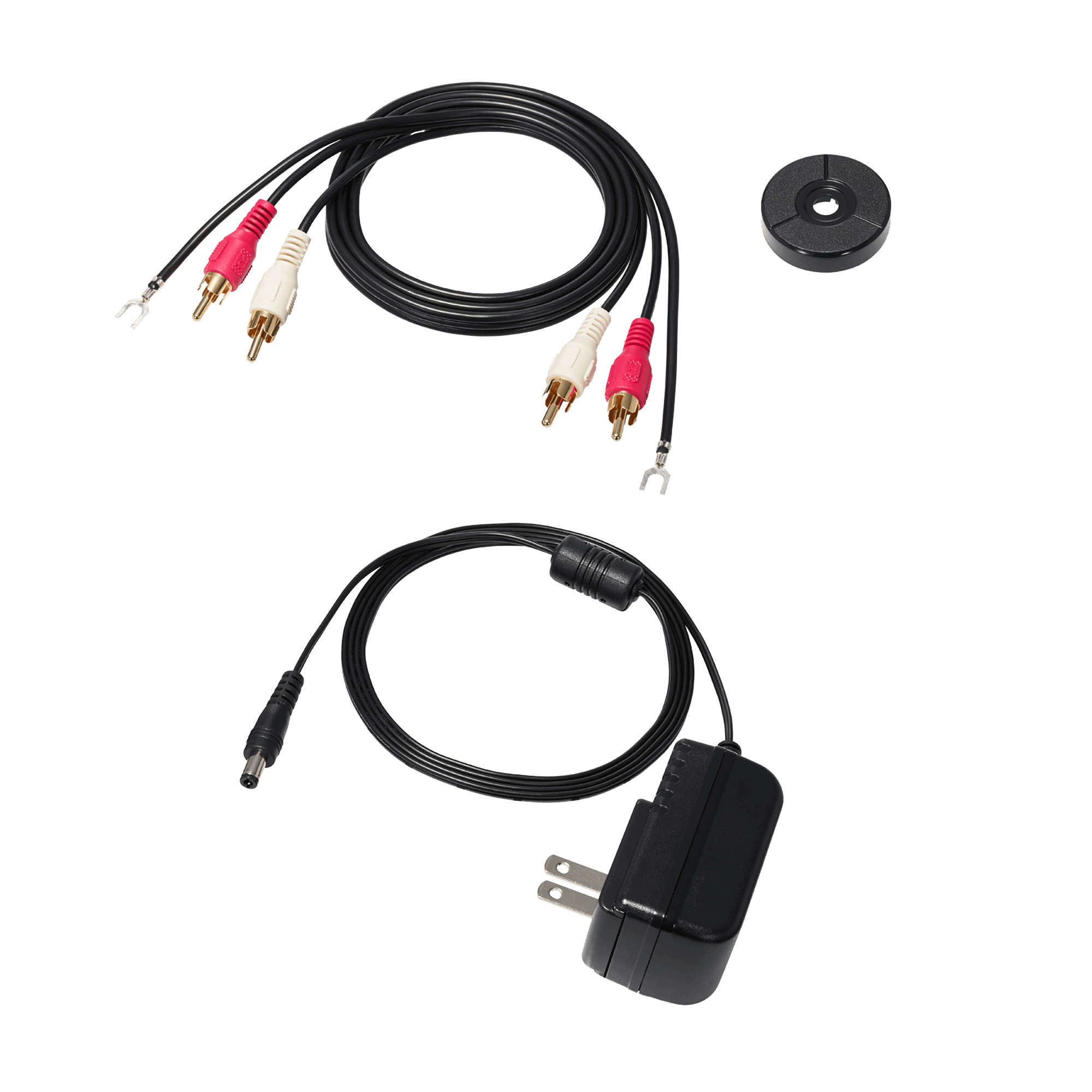
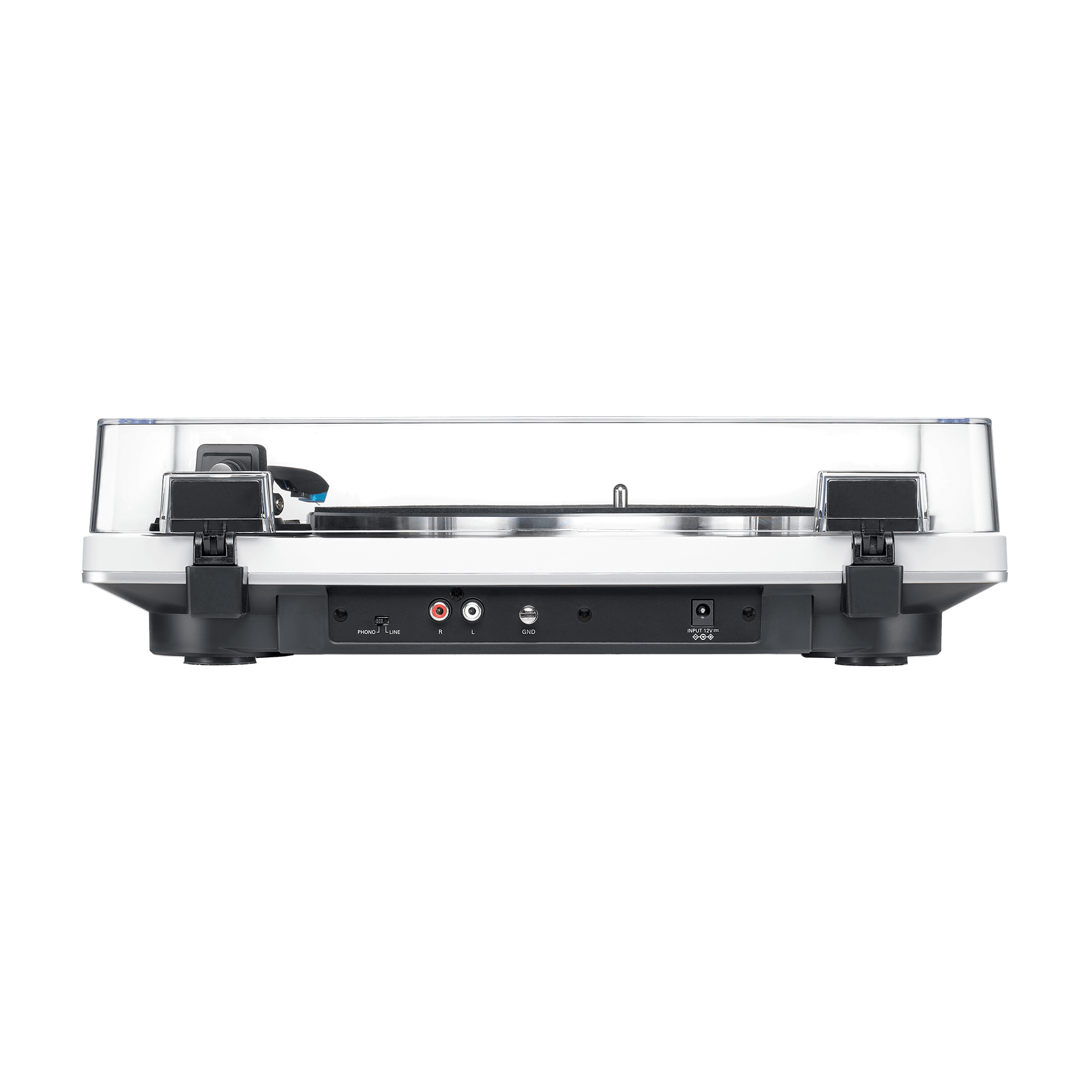
The built-in phono stage allows the AT-LP70X to connect to suitable powered speakers, so a separate phono preamplifier is not required for that connection path. The output setting still needs to match the input being used. For an amplifier with a dedicated phono input, the documented instruction is to select PHONO. This makes input checking a meaningful part of choosing a first system: the presence of a preamp inside the turntable does not remove the need to identify the receiving equipment's connection. Recordbuilds describes the direct powered-speaker route as one of the model's conveniences, and HiFiReport explains the phono-input setting. Buyers should therefore decide the connection arrangement before treating the turntable as ready for their existing speakers. The evidence supports an analog system assembled around compatible inputs; it should not be stretched into a claim that every speaker, receiver, or unrelated connection method will work. [1], [4], [6], [2]
Comparison with the AT-LP3XBT
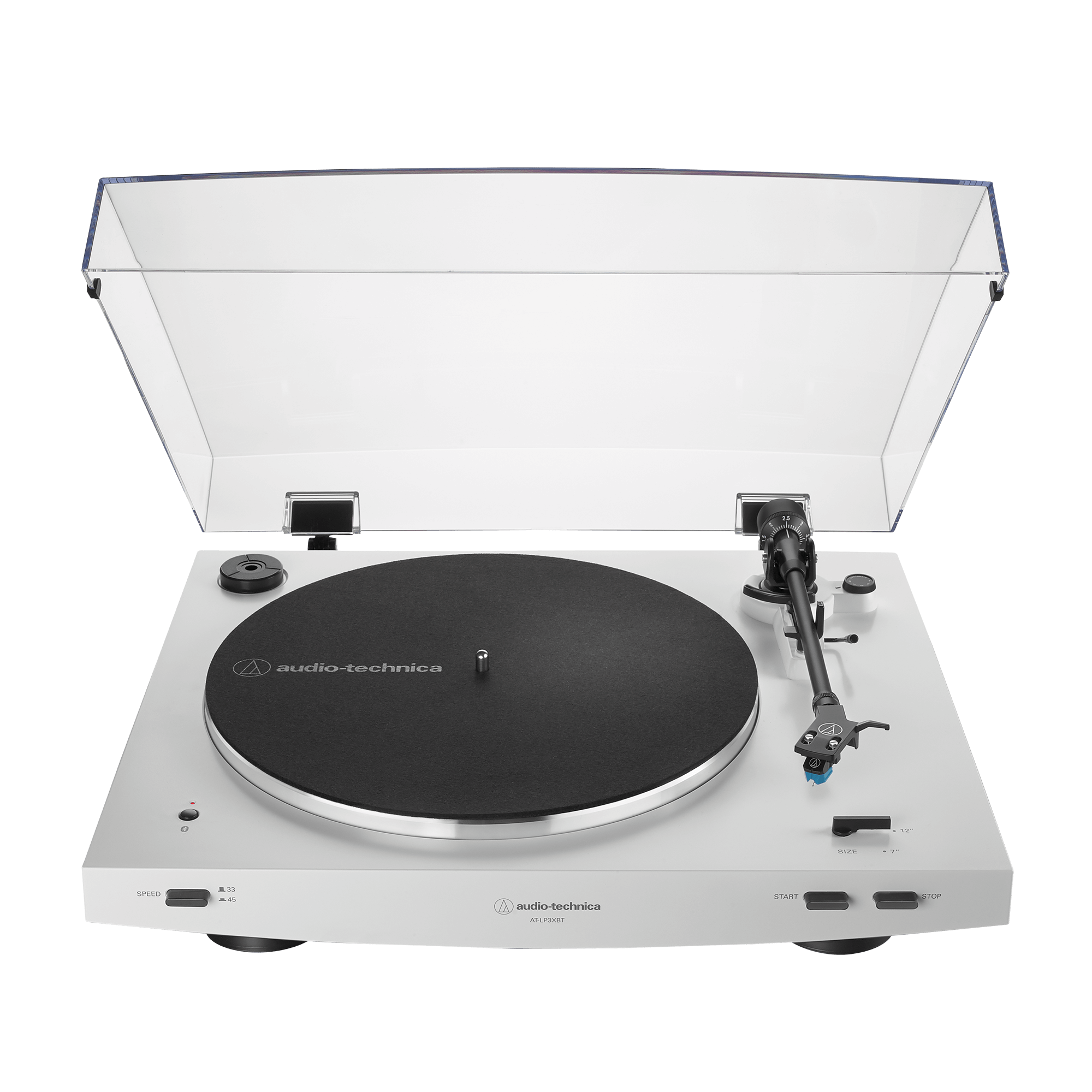
The inherited comparison identifies the Audio-Technica AT-LP3XBT as an alternative with automatic playback and a built-in phono stage. Its stored specification lists 0.2% wow and flutter, while the AT-LP70X manual lists a limit below 0.25%. That is a comparison of published figures, not a matched laboratory test proving the rival sounds better. The inherited rival evidence also identifies a removable headshell and a broader cartridge-change route, whereas the AT-LP70X's cartridge is fixed. These are useful differences when the purchase goal is future cartridge experimentation. Keep the comparison tied to that goal rather than treating one number as a universal winner. The rival evidence was inherited in this refresh and has not been newly tested here. A reader considering either model should distinguish the specific documented feature differences from claims about actual performance that would require comparable test conditions. [1], [4], [7]
Choose the AT-LP70X when your priorities are its two documented record speeds, automatic start and return, and a first analog system built around suitable powered speakers or an amplifier. Accept the fixed cartridge as part of that decision and use the compatible stylus path if later replacement or upgrading matters to you. Reconsider the fit if changing complete cartridge bodies is a primary requirement. Before buying, check the input on your intended speaker or amplifier, identify the appropriate output setting, and confirm that you have a level place for the turntable. Retain the manual's qualification about automation on some records. This combination of features supports a conditional recommendation for convenience-focused listeners: it gives a documented operating path and replacement route, while leaving exact-unit measurements and broader compatibility questions open instead of promising performance the sources do not establish. [1], [4], [7], [2], [3]
Playback specifications
The Audio-Technica AT-LP70X is a belt-drive turntable that plays 33-1/3 RPM and 45 RPM records. Those are the two supported playback speeds established by the manual. Before buying, match those options to the records you intend to play rather than assuming the deck covers every historical format. Audio-Technica specifies wow and flutter below 0.25% WTD and a signal-to-noise ratio above 55 dB. The direction of each limit matters: the first is an upper bound and the second is a lower bound. Neither should be rewritten as an exact test result. These figures describe the manufacturer's specification for the model; the sources used here do not establish laboratory measurements of the particular unit identified by this listing. For a buyer, the useful distinction is between a documented baseline and independently demonstrated performance under stated conditions. This article has the former, while the latter remains an evidence gap. [1], [7], [5]
The supplied AT-VM95C is a dual-moving-magnet cartridge, and the manual explicitly says the cartridge cannot be removed. That makes the upgrade path narrower than the cartridge name alone might suggest. A stylus replacement is supported, and the AT-VMN95C is identified as a compatible replacement for the AT-VM95C cartridge. Recordbuilds also describes a route to other compatible styli without replacing the entire turntable. The buyer implication is practical: plan an upgrade around the supported stylus family rather than around fitting a different complete cartridge body. This is useful for someone who wants to begin with the supplied setup and make a later change to the replaceable part. It is less suitable for a buyer whose main objective is experimentation with many cartridge bodies. Compatibility establishes a replacement route; it does not establish how much a particular upgrade will improve sound in your system. [1], [4], [3]
Setup and buyer fit
Audio-Technica instructs users to place the turntable on a level surface. That requirement belongs in the buying decision as well as the setup checklist: choose the location before assuming automatic operation removes every installation consideration. The documented die-cast aluminum platter describes a construction detail, while Recordbuilds' description of the deck as simple without feeling cheap remains a subjective impression. The two statements serve different purposes and should not be combined into a claim of measured vibration isolation. Long-term ownership also includes a replaceable stylus. The manual gives 300 hours of use as a rule of thumb for stylus replacement; this is manufacturer maintenance guidance, not a measured lifespan guarantee. Identifying the AT-VMN95C replacement makes that guidance actionable. A buyer can plan to monitor usage and arrange a compatible replacement, while recognizing that the available evidence does not establish the total monetary cost of ownership. [1], [4], [6], [7], [3]
HiFiReport provides an independent listening account for the AT-LP70X, describing an audition with an Advance Paris PlayStream A7 amplifier and Pioneer S-1EX speakers. Naming the associated equipment makes the listening context clearer than an unsupported statement that the turntable sounds good in every system. It does not turn the review into a physical benchmark. No measured speed error, tracking-force result, or laboratory noise result for this exact assigned variant is stored here. Keep that distinction when comparing the manufacturer limits with a reviewer's listening impressions. The fixed cartridge and compatible stylus route remain documented features, but an upgrade's benefit depends on evidence that specifically addresses the change and its test conditions. The useful conclusion is bounded: there is both manufacturer documentation and independent listening experience for the model, while quantitative performance evidence for the assigned unit and hardware revision remains unresolved. [1], [4], [2]
Alternatives
| Alternative | Where this Product wins | Where it loses | Pick it if |
|---|---|---|---|
| Audio-Technica AT-LP3XBT-WH Fully Automatic Wireless Belt-Drive Turntable (White) | The AT-LP70X offers automatic playback and a built-in phono stage, matching the rival on those convenience features. [1], [7] | The AT-LP70X is specified below 0.25% wow and flutter, while the rival is specified at 0.2%; these are published figures, not a matched test. [1] The AT-LP70X cartridge is fixed; the rival supports later cartridge changes through a removable headshell. [1], [4] | Choose the AT-LP70X for fixed-cartridge simplicity and compatible stylus replacements; consider the AT-LP3XBT for broader cartridge flexibility. Published wow-and-flutter figures alone do not establish a listening winner. |
| Specification | Audio-Technica AT-LP70X Fully Automatic Belt-Drive Turntable (White/Silver) | Audio-Technica AT-LP3XBT-WH Fully Automatic Wireless Belt-Drive Turntable (White) |
|---|---|---|
| Built-In Phono Preamp | Yes [1] | Yes |
| Automation | Automatic start and end-of-record tonearm return [1], [7] | Automatic start and tonearm return |
| Wow and Flutter | 0.25 % [1] | 0.2 % |
| Use Case | Stylus can be upgraded without replacing the turntable [4] | The removable headshell and cartridge family support later stylus or cartridge changes. |
Buyer questions
Compatibility
Which record speeds does the AT-LP70X support?
It supports 33-1/3 RPM and 45 RPM records. [1]
Setup
Does it include a phono preamp?
Yes. The built-in phono stage allows connection to powered speakers and supports selectable output routing. [1], [4], [6]
What surface does it need?
The manufacturer instructs users to place it on a flat, level surface. [1]
Everyday use
Product images
Facts and specifications
Manufacturer manual
| Specification | Value | Source |
|---|---|---|
| Automation | Automatic start and end-of-record tonearm return | [1], [7] |
| Drive Type | Belt drive | [7], [5] |
| Included Cartridge | AT-VM95C Dual Moving Magnet Stereo Cartridge | [1] |
| Built-In Phono Preamp | Yes | [1] |
| Signal-to-Noise Ratio | 55 dB | [1] |
| Playback Speeds | 33-1/3 RPM and 45 RPM | [1] |
| Wow and Flutter | 0.25 % | [1] |
Retailer listing
| Specification | Value | Source |
|---|---|---|
| Compatibility | AT-VMN95C is a conical replacement stylus for the AT-VM95C cartridge. | [3] |
Stated by reviewers
| Specification | Value | Source |
|---|---|---|
| Automation | Fully automatic | [6] |
| Interface | Built-in preamp allows direct connection to powered speakers | [4] |
| Materials | Die-cast aluminum platter | [4] |
| Built-In Phono Preamp | Yes | [6] |
Other facts
| Specification | Value | Source |
|---|---|---|
| Buyer Fit | Suitable as a beginner turntable | [6] |
| Limitation | Automatic operation may not work at the start or end of some records. | [7] |
| Setup Requirement | Place the turntable on a level surface; The manual gives 300 hours of stylus use as a replacement rule of thumb.; Use the PHONO selector position when connecting to an amplifier's dedicated phono input. | [1], [7], [2] |
| Use Case | Stylus can be upgraded without replacing the turntable | [4] |
KnowSpec analysis
Who the Audio-Technica AT-LP70X suits
The AT-LP70X suits first-time vinyl buyers who want automatic start and return, 33-1/3 RPM and 45 RPM playback, and a built-in phono stage. Its fixed AT-VM95C cartridge simplifies the choice but prevents broader cartridge swapping; compatible styli remain the upgrade route. Manufacturer wow-and-flutter and signal-to-noise limits describe published specifications, not measured performance of the assigned unit. Buyers should check speaker inputs, choose the matching output setting, and accept the manual's caveat that some records may not trigger automation correctly.
Method: Manufacturer documentation and attributed independent review synthesisVisible information gaps
Missing information is shown rather than guessed.
- Topic:Limitationsnot found
- Topic:Tracking Force And Alignmentnot found
- Risknot public
Products in this content
-
Audio-Technica AT-LP3XBT-WH Fully Automatic Wireless Belt-Drive Turntable (White)
Automatic operation and a built-in phono stage suit listeners who value simpler handling. Sound Matters describes warm, smooth listening with t
-
Audio-Technica AT-LPGO-BT Fully Automatic Wireless Belt-Drive Turntable (Gun-Metal/Black)
The AT-LPGO-BT fits a home listening system when automatic start and return and Bluetooth or RCA connections are priorities. Choose the receivi
Sources and method
- AT-LP70X User ManualAudio-Technica · retrieved 2026-09-28ManualPDF
- Audio-Technica AT-LP70X ReviewHiFiReport · retrieved 2026-10-08Editorial review
- Audio-Technica AT-VMN95C stylusLP Gear · retrieved 2026-10-08Retailer listing
- AT-LP70x Review: The Beginner Table to BeatRecordbuilds · retrieved 2026-09-28Editorial review
- Audio-Technica AT-LP70X Fully Automatic Belt-Drive TurntableLP Gear · retrieved 2026-10-08Retailer listing
- Audio-Technica AT-LP70X and Edifier R1280T – A Full ReviewRecordbuilds · retrieved 2026-09-28Editorial review
- AT-LP70X User ManualAudio-Technica · retrieved 2026-10-08ManualPDF