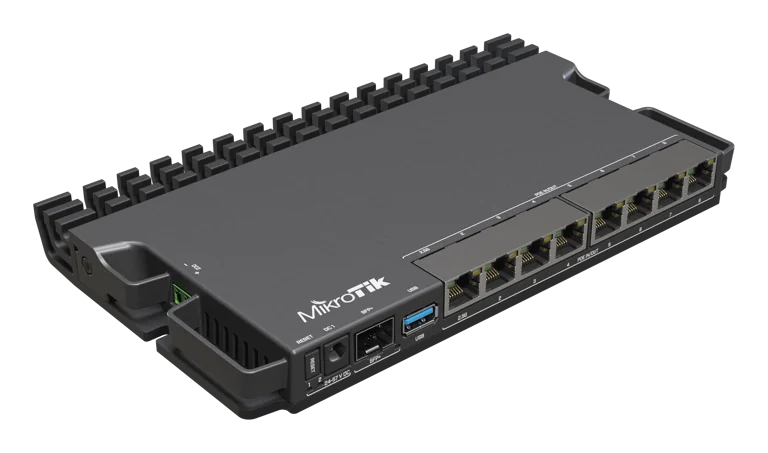
MikroTik RB5009UPr+S+IN PoE Ethernet Router
Choose the RB5009UPr+S+IN when you want RouterOS and wired PoE connectivity, not when you need a researched all-in-one wireless recommendation. The accepted evidence supports its Ethernet and SFP+ interfaces, fanless operation and a measured idle draw, but leaves wireless coverage, multi-client capacity and extended endurance unverified. Its routing and IPsec figures describe particular tests rather than a guarantee for every configuration.
Updated 2026-10-11

We may earn a commission from qualifying purchases.
Prices and sellers
No price information yet
Areas not yet researched (7)
No conclusion is available for these areas. This does not mean the Product has no limitations or reported issues.
- Conditions and limitations
- Compatibility
- Where sources differ
- Reported issues and fixes
- Care and support
- Ownership costs
- Who it suits
Specifications
Idle power
7.4 WReviewer-observed idle power · Idle reading reported by ServeTheHome. Sample size, meter, firmware, ambient temperature and exact cable configuration are unspecified; this is not a loaded PoE-system measurement.
Source [3]Routing throughput
9851.4 MbpsXenaBay all-port fast-path routing test with no rules · RFC2544 · 1518-byte packets; attempts of 30+ seconds; 0.1% packet-loss tolerance. Sample size and RouterOS version are not stated. Manufacturer maximum-performance result, not independent testing.
Source [5]Ipsec throughput
1354.1 MbpsXenaBay single-tunnel AES-128-CBC + SHA1 test · RFC2544 · 1400-byte packets; attempts of 30+ seconds; 0.1% packet-loss tolerance. Sample size and RouterOS version are not stated. This configuration does not establish performance for other ciphers or tunnel counts.
Source [5]Reviewer consensus
Consensus rows require at least two distinct sources for the topic.
| Topic | Positive | Negative | Mixed | Reading | Evidence |
|---|---|---|---|---|---|
| Ethernet wan lan | 2 | 0 | 0 | Agreed · 2/2 | [7], [5] |
| Measured performance | 2 | 0 | 0 | Agreed · 2/2 | [7], [5] |
Single-source notes
The review
MikroTik RB5009UPr+S+IN: PoE compatibility, routing tests and power limits
Who it suits and what the evidence covers
The MikroTik RB5009UPr+S+IN is a wired RouterOS choice for buyers who specifically want PoE connectivity. Its documented interfaces combine seven Gigabit Ethernet ports, one 2.5G Ethernet port and one 10G SFP+ cage. The exact-model manual identifies the 88F7040 processor, while ServeTheHome's hardware inspection also confirms a USB port. These details help map a proposed installation: identify which connection needs the faster copper port and which will use SFP+ before counting the remaining wired endpoints. They do not establish a wireless coverage area. The model suffix matters because this research concerns the indoor UPr version, not an interchangeable claim about every RB5009. Treat ServeTheHome's favorable RouterOS and PoE buyer assessment as an editorial opinion supported by its inspection, rather than a promise that the interface layout will suit every network. A buyer should compare that layout with the actual upstream connection and downstream equipment. [3], [7], [4]
Routing is not the same test as IPsec
MikroTik reports 9851.4 Mbps for all-port fast-path routing with 1518-byte packets. Its methodology names XenaBay equipment, RFC2544, attempts lasting 30+ seconds and a 0.1% packet-loss tolerance. This is a manufacturer's maximum-performance benchmark, not an independent endurance result. Dennis Schröder separately reports obtaining 9 Gbit/s through the SFP+ slot in his own use of the UPr model. His written account does not provide enough traffic-generator, packet-size, firmware or duration detail to reproduce that result as an equivalent laboratory test. We therefore retain it as a reviewer-stated observation and do not merge it with the manufacturer's figure or turn it into a guaranteed connection speed. For a purchase decision, the distinction is useful: the independent report suggests substantial throughput in one setup, but it leaves the effect of your own rule set and traffic mixture unresolved. Neither source establishes a sustained-performance guarantee for an unspecified installation. [5], [2]
The manufacturer's single-tunnel AES-128-CBC + SHA1 result is 1354.1 Mbps with 1400-byte packets. The published methodology again uses XenaBay and RFC2544, with 30+ second attempts and a 0.1% loss tolerance; the sample size is not stated. Ordinary fast-path routing and this encrypted tunnel are distinct configurations. A faster routing number cannot be substituted for the tunnel result, and the tunnel result cannot certify another cipher, packet size or tunnel count. Buyers planning encrypted links should compare the published configuration with their intended workload before interpreting either headline number. The research does not supply the complete inputs needed for a separate Ethernet-payload or wireless-backhaul calculation, so it asserts no such formula result. There is also no newly established long-duration VPN test here. These limits are relevant even when an interface's advertised link rate looks sufficient: the available evidence describes selected benchmark conditions, not every function that might run simultaneously. [5]
PoE compatibility and the idle measurement
PoE-in and PoE-out across the eight Ethernet ports do not make their input compatibility identical. MikroTik explicitly restricts active 802.3af/at input to Ether1. A plan to feed the router through another port therefore needs a separate compatibility check rather than an assumption based on the general PoE label. The manufacturer brochure hosted by NETXL adds a useful operating detail: when available power is insufficient, lower-priority PoE-out ports can be disabled, and the installer can set those priorities. That behavior makes the choice of which endpoints should remain powered part of the installation plan. It is a documented control policy, not evidence that an arbitrary collection of attached devices will stay online through every supply failure. Review the intended input source and the downstream power requirements together. Do not treat a port count as a power budget, or interpret the existence of several input paths as a measured guarantee of uninterrupted service. [5], [1]
ServeTheHome observed an idle draw around 7.4 W and describes a fanless unit. This is the independently measured power result in the evidence, separate from the manufacturer's throughput tests. The article does not state the sample size, measuring instrument, firmware, ambient temperature or exact cable arrangement for the idle reading. Those fields remain unknown rather than being reconstructed from neighboring sentences about maximum consumption. In particular, this observation does not represent the total demand of a loaded installation supplying downstream PoE devices. Fanless construction can be relevant where fan noise is undesirable, but it is not a measured acoustic spectrum or proof of thermal endurance. Treat the idle figure as a reference point for the reviewed setup. A buyer whose main concern is energy consumption under an actual PoE load still needs a measurement of that configuration; this research cannot derive it reliably from the idle value alone. [3], [3]
Secure setup and unresolved questions
The exact-model manual tells the installer to set a password to secure the device. That step belongs in the setup plan alongside checking the intended PoE input; neither should be left to an assumption that the router's physical connections are interchangeable. The inherited evidence gaps remain open for sustained throughput, wireless standards and range, multi-client capacity, mesh behavior, parental-control apps and long-term reliability. An unanswered topic is not a claim that a feature exists or is absent. The evidence also retains an unresolved disagreement between the official product page and manual about low-voltage PoE-out current. This article does not choose a preferred current limit to make that discrepancy disappear. Ask for exact-model and hardware-specific clarification if the intended load depends on it. For a buyer, these gaps define the boundary of the recommendation: documented wired interfaces, selected tests and explicit PoE restrictions are supported, while a broader all-in-one networking or endurance promise is not. [7], [5]
How to use the evidence
The source set includes the manufacturer's product page and manual, a manufacturer brochure hosted by NETXL, the two pages of ServeTheHome's firsthand review, and Dennis Schröder's written review. Separate URLs are not separate experiments: the two ServeTheHome pages belong to one review, and a distributor-hosted brochure remains manufacturer material. A GETIC listing exceeded the snapshot size limit, and the manufacturer's CDN PDF denied snapshot access through its robots policy. Those attempted URLs are recorded as access gaps, not counted as verified evidence. This update preserves unresolved questions rather than using source quantity as proof of completeness.
Buyer questions
Before you buy
Compatibility
Can every Ethernet port accept active 802.3af/at power?
No. The manufacturer explicitly limits 802.3af/at PoE input to Ether1. PoE-in and PoE-out across the Ethernet ports do not mean identical active-input compatibility. [5]
Setup
What security step does the manual explicitly require?
Set a password to secure the device. The accepted evidence does not evaluate a parental-control app, so this package makes no promise about that feature. [7]
Everyday use
What does the independent idle-power test show?
ServeTheHome reported 7.4 W at idle and described a fanless unit. That is not a measurement of a fully populated PoE installation or long-term reliability. [3]
Limitations
Does the routing result guarantee the same speed for IPsec?
No. The cited fast-path routing result is 9851.4 Mbps, while the cited single-tunnel AES-128-CBC + SHA1 IPsec result is 1354.1 Mbps. They are different test configurations, not interchangeable promises. [5]
Product images
Facts and specifications
Manufacturer datasheet
| Specification | Value | Source |
|---|---|---|
| Ports | PoE-in and PoE-out on all eight Ethernet ports | [5] |
| Power Source | The manufacturer describes disabling lower-priority PoE-out ports when available power is insufficient; port priority is manually configurable. | [1] |
Manufacturer manual
Stated by reviewers
Measured by a lab
Other facts
| Specification | Value | Source |
|---|---|---|
| Buyer Fit | Suitable for buyers who want RouterOS and PoE/PoE+ connectivity. | [3] |
| Limitation | 802.3af/at PoE input is supported only on Ether1; do not assume equivalent active PoE input on every Ethernet port. | [5] |
| Setup Requirement | Set a password to secure the device. | [7] |
| Use Case | Fanless cooling suits installations where fan noise is undesirable; it is not evidence of long-term reliability. | [3] |
KnowSpec analysis
Who this wired PoE router suits
Choose the RB5009UPr+S+IN when you want RouterOS and wired PoE connectivity, not when you need a researched all-in-one wireless recommendation. The accepted evidence supports its Ethernet and SFP+ interfaces, fanless operation and a measured idle draw, but leaves wireless coverage, multi-client capacity and extended endurance unverified. Its routing and IPsec figures describe particular tests rather than a guarantee for every configuration.
Method: evidence_synthesisVisible information gaps
Missing information is shown rather than guessed.
- Topic:Limitationsrights restricted
- Mesh Supportnot found
- Topic:Multi Client Capacitynot found
- Topic:Thermals And Reliabilitynot found
- Wifi Standardnot found
- Topic:Sustained Performancenot found
- Coverage Areanot found
- Topic:Limitationsconflicting
- Topic:App Parental Controlsnot found
Products in this content
-
GL.iNet GL-MT300N-V2 Mango N300 Mini Travel Router
The Mango GL-MT300N-V2 suits travelers who value a pocket-size router, flexible uplinks and router-level VPN configuration more than broadband speed. Its single-band Wi-Fi and Fast Ethernet make it a conditio
-
GL.iNet GL-AR300M16 (Shadow) N300 Mini Travel Router
The GL-AR300M16 is a conditional choice for travellers who value a tiny, configurable network more than throughput. Its internal antennas and Micro-USB power connection keep the kit compact, while the single-
-
NETGEAR Nighthawk R6900P AC1900 Dual-Band WiFi Router
The R6900P is difficult to recommend as a new primary Internet router. NETGEAR marks it end-of-support and recommends retirement. Its remaining wired, wireless and local-storage functions can
-
TP-Link Archer AX6000 AX6000 Dual-Band Wi-Fi 6 Router
Consider the Archer AX6000 if you want a Wi-Fi 6 router with many wired connections and configurable household controls, provided you can verify the supplied revision and its current support.
-
NETGEAR Nighthawk AX12 RAX120 AX6000 Dual-Band WiFi 6 Router
Do not buy an unidentified RAX120 for a new security-dependent Internet connection on the strength of its AX6000 label. This ASIN maps to RAX120-100NAS but does not establish v1 or v2. NETGEA
-
TP-Link Archer AX21 AX1800 Dual-Band Wi-Fi 6 Router
The Archer AX21 is worth considering when replacing an old router with Wi-Fi 6, provided you do not need advanced parental controls or guaranteed coverage at a distance. Check the unit’s hardware revision bef
Sources and method
- RB5009UPr+S+IN brochureMikroTik (brochure hosted by NETXL) · retrieved 2026-10-11DatasheetPDF
- Mikrotik RB5009UPr Unboxing, Review und Performance TestDennis Schröder · retrieved 2026-10-02Lab review
- MikroTik RB5009UPr+S+IN PoE Router Mini Review page 2ServeTheHome · retrieved 2026-10-11Lab review
- MikroTik RB5009UPr+S+IN PoE Router Mini ReviewServeTheHome · retrieved 2026-10-11Lab review
- MikroTik RB5009UPr+S+INMikroTik · retrieved 2026-10-02Manufacturer
- MikroTik RB5009UPr+S+IN PoE Router Mini Review page 2ServeTheHome · retrieved 2026-10-02Lab review
- RB5009UPr+S+IN user manualMikroTik · retrieved 2026-10-02Manual